GUEST APPEARANCE · AUGUST 22, 2023 · PENPODCAST
How I Turn Big Ideas Into Children’s Books Families Read Again and Again
Matthew Harms and I talked about the artistic choices behind my books, what live audiences taught me about holding a child’s attention, and how Dinosaur House turns an expert’s idea into a story children genuinely enjoy.
WATCH THE ORIGINAL INTERVIEW
Pages & Playtime: Inside a Children’s Book Author’s ImaginationWatch on YouTube ↗A children’s book should never feel like an adult idea that has been shortened, softened, and pushed toward a child. The work begins by taking the child seriously.
That principle connects nearly everything Matthew and I discussed: the artwork taped across my office walls, the story I began for my little brother, the reactions I watch for during school performances, the entrepreneurship ideas inside Lucas the Dinosaur Entrepreneur, and the process my team uses to turn an industry leader’s point of view into a real book.
The conversation also helped me articulate why children’s books can be unusually powerful assets. A conventional business book may be read once—or purchased and never opened. A children’s book that a child loves can be requested over and over, becoming a recurring conversation between an adult and a child.
What Matthew and I explored
- why I think of myself as a story artist rather than only a writer or illustrator;
- how I use reaction triggers to keep children emotionally involved on every page;
- why a writer must enter a child’s worldview before introducing a bigger idea;
- how a children’s book serves the child who rereads it and the adult who chooses it;
- how theme discovery becomes a child-friendly hero’s journey;
- why spaceships, dinosaurs, fairies, and even space puppies can clarify an adult profession; and
- how Dinosaur House carries a project from the initial idea through writing, illustration, and publication.
I Wanted to Be a Story Artist Before I Knew the Form
I always knew I wanted to use art to tell stories. I did not know whether that would mean comic books, animation, storyboards, concept art, or illustration. When I was seventeen, I began making a book for my four-year-old brother, Tristan, as a way to connect with him. That project became Billy the Dragon, and it gave the larger ambition a specific form.
I described myself to Matthew as a slow illustrator. In many commercial art environments, speed is a major constraint. A picture book gave me room to build images deliberately and let the writing and visual storytelling develop together.
The walls of my workspace reflect that process. After visiting Disney artist Lon Smart and seeing concept art covering his office, I began surrounding myself with artwork I could study. If I am struggling with a landscape or composition, I want references close enough that inspiration is part of the room—not something I have to go searching for after I get stuck.
I Design Every Page Around a Reaction
My writing philosophy is built around what I call reaction triggers. On every page, I want to give the child a reason to respond physically or verbally. The response might be laughter, surprise, suspense, fear, disgust, anticipation, or delight. If nothing changes inside the reader, I have probably wasted the page.
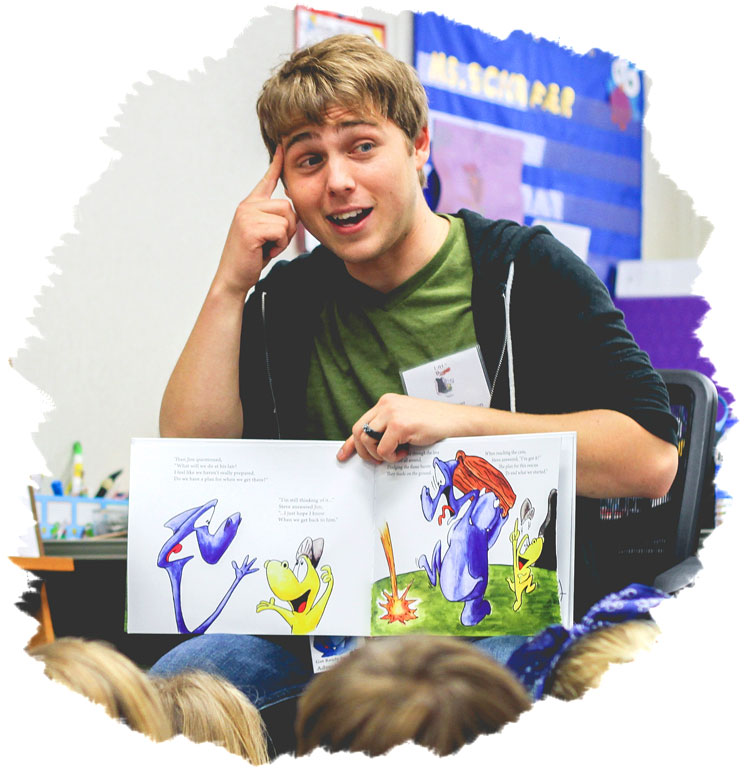
That does not mean every spread needs a joke or a loud spectacle. Suspense is a reaction trigger. So is recognition. When I perform for students, I can see their bodies change when a moment works: they lean in, widen their eyes, laugh together, call something out, or wait quietly because they need to know what happens next.
Illustration serves the same goal. I am less interested in whether an image looks classically impressive than whether it amplifies the moment the child is supposed to feel. The facial expression, pose, framing, color, and background all have a job to do.
Every page should give the child something worth reacting to.
Enter a Child’s World Before Inviting Them Into Yours
A big idea does not become child-friendly merely because the sentences get shorter. I first have to remember what felt important, hilarious, frightening, or exciting when I was seven or eight. That is what it means to enter a child’s world.
Once I have entered that world honestly, I can invite the reader into mine. If I want children thinking about entrepreneurship, purpose, generosity, writing, or responsibility, the story needs to begin with elements they already care about. Dinosaurs, rockets, dragons, fairies, pirates, animals, and impossible worlds are not decorations pasted onto a lesson; they are the imaginative language through which the idea becomes accessible.
That is why Lucas the Dinosaur Entrepreneur is not simply a story about a child running the predictable lemonade stand. Lucas is a dinosaur who wants to become his own boss. He considers what he loves, what he already does, and what another character needs. The business lesson emerges from an adventure and a recognizable problem rather than from a lecture.
The Book Has to Work for a Child and an Adult
A children’s book nearly always has two audiences. The adult often purchases the book. The child determines whether it will ever be requested again.
This creates a useful creative standard: the idea must matter to the adult, while the experience must belong to the child. If the message is worthy but the story is boring, the book may be purchased once and ignored. If the story is entertaining but the adult cannot see why it belongs in the family, the book may never enter the home.
When both sides work, something unusual happens. A parent can talk about work, purpose, values, or a difficult idea through a story the child has requested. The conversation is not forced. It is prompted by the child’s affection for the book.
That repeatability is one reason I believe a strong children’s book can carry an idea farther than many conventional business books. A book a child genuinely loves may be read dozens or even hundreds of times. With every reading, the idea becomes part of a shared family memory.
The Story Starts With Theme Discovery
When Dinosaur House begins a project, we do not start by asking the client to write a manuscript or describe an illustration. We begin with a theme-discovery conversation.
I want to understand the idea that feels essential to the person: What do you believe that people in your field do not say often enough? Why does it matter? What is painful about living opposite that idea? What becomes difficult when someone tries to live according to it? What is worthwhile on the other side?
Those questions reveal the emotional movement underneath the expertise. From there, I can begin to see a hero’s journey: a character lives opposite the theme and experiences the consequences, recognizes what they want, disrupts their life to pursue it, encounters the real difficulty of change, and eventually experiences the value of what they have learned.
Matthew offered “giving a voice to people who might not otherwise have one” as a core belief from his ghostwriting work. Within minutes, that idea gave us a character problem, an emotional cost, a reason to continue despite difficulty, and the beginnings of a story arc. The professional insight was becoming narrative material.
Translate the Profession Into an Adventure
After theme discovery comes plot selection. This is where I look for alignment between the client’s idea and things children already love. Could the character be a dinosaur, narwhal, dragon, pirate, fairy, or unicorn? Does the story belong in the past, the future, outer space, or a world governed by a strange imaginative rule?
One of my favorite examples is a book about being a compliance officer. On the surface, compliance might not sound like the obvious foundation for an irresistible children’s adventure. But the challenge is exactly what interests me: how can we communicate what this profession actually protects and why it matters through a world a child wants to enter?
Our answer used spaceships and space puppies. The imaginative setting did not trivialize the profession. It gave the underlying idea a visible problem, memorable stakes, and a language a family could share.
The goal is not to disguise a career brochure as a picture book. The goal is to discover the human truth within the profession and dramatize it through a story that works on its own.
A Complete Book Requires More Than a Manuscript
People sometimes assume they need to know how to write or draw before approaching Dinosaur House. They do not. The expertise and point of view have to come from the client, but our job is to carry that material through the complete creative process.
- Theme discovery: We identify the belief, audience, stakes, and emotional movement beneath the idea.
- Story design and plot selection: We translate the theme into a child-centered world and a coherent journey.
- Manuscript development: A ghostwriter creates the story, then we revise it with the client until both the idea and the reading experience work.
- Visual storytelling: We build a sketched storyboard so the entire book can be evaluated before final illustration.
- Illustration and publication: Once the storyboard is approved, the art is completed and the book is prepared and published.
The client remains the author because the belief, expertise, decisions, and final approval are theirs. Our team provides the process and the children’s-storytelling experience required to turn those ingredients into a finished book.
Why a Children’s Book Can Become a Lasting Asset
Near the end of our conversation, Matthew described the strategic difference clearly. A leader who writes another conventional business book enters a crowded shelf. A children’s book can express the same underlying belief in a form that very few peers have created.
But standing out is only the surface-level benefit. The deeper value is access to a different part of the audience’s life. A good children’s book is not content someone consumes alone during work. It can become a moment between a parent and a child—a way to explain what Mom or Dad does, talk about a value, or imagine a future together.
That is the work I want to keep doing: making books that children genuinely enjoy while giving adults a better way to pass something meaningful forward.
Original Interview and Related Reading
This first-person article is based on my guest appearance on PenPodcast: Inked Conversations with Authors and Industry Experts, hosted by Matthew Harms. PenPodcast created and published the original interview.
Read the complete interview transcript30-minute interview · Matthew Harms and Timmy Bauer
This transcript was generated from the original video and lightly formatted for readability. It preserves the complete conversation.
[Music] welcome back everybody to the newest episode of penpodcast.com I'm your host Matthew harms founder of the pen podcast where we feature authors writers writing industry professionals subject matter experts and all around interesting people also the founder of pen for hire where we help subject matter experts tell their stories and today we have the pleasure of being joined by Timmy Bauer how are you Timmy I'm doing great Matthew thank you so much for having me on God is my pleasure I had such a great time on your podcast that um I just had to continue the conversation on mine yeah if you guys want to hear Matthew harms on my podcast it's called writing better we'll make sure we link this to that one as well always appreciate the um podcasters helping podcasters and I just really I don't think you had this in the background the last
time but I'm completely for those who are listening they're not going to see but go over to YouTube um I love the illustrations on your wall oh thank you this okay so um this is a much crappier version of what I used to have uh I so I live in an apartment now but um I was inspired to do this by a artist that I met at Disney so I used to work at Disney as a performer and I met one of the he's the head artist for Walt Disney World um his name's lawn smart and he what used to be an animator for the company like he worked on Emperor's New Groove and a bunch of other uh movies and I went and had lunch with him in his office and as soon as I walk into his office from floor to ceiling there's artwork just taped to the walls and it's um it's the artwork from if you've ever read any of those art of uh books that are like art of the movie Up art of
the movie Wally art of XYZ right you flip through them it's all this beautiful sketch work and concept art and all this kind of stuff and I was like this is amazing floor to ceiling every wall covered in he just like taped the like ripped out pages and taped them to the walls and he was like yeah because I get super inspired when I flip through these books but I have to flip through the books you know to get inspired but I need to be inspired all day long so when I'm working at my desk if I ever just need some inspiration I'll just scoot my chair back and spin it around and I literally just like floor to ceiling have all this inspirational artwork like let's say I'm struggling to work out how I'm going to draw a scene I can just spin my chair around and see all these examples of other people that have drawn other scenes and I was like
that's genius if I ever have an office uh I'm going to do the exact same thing to my office well this is my closet office and so I ripped out a bunch of pages from a bunch of art of books and taped them to the wall that's incredible um it's kind of like the um you know like the what's the word now it's going to escape me because it was right on the tip of my tongue um like vision boards right like that because for me I can't I know I can't draw and we're going to come back to what you actually do now that we've covered the drones on your wall but I I totally get that inspiration of like especially having a terrible day a hard day and you turn around and you see that vacation you want to go on you see that new car that boat and it really just gets your head back in the right mind space to keep doing what you need to do yeah well I've
always struggled with drawing landscape so I'm a kids book author when I did my first book Billy the dragon um I I've always struck I've always been stronger with um character Expressions than like landscape drawing so I really struggled with the backgrounds so um I took a lot of inspiration from uh tear outs of art of uh stuff specifically Winnie the Pooh like Winnie the Pooh the movies they have beautiful background art and so I literally as I was painting all the scenes for Billy the dragon I uh I had Winnie the Pooh's uh background Stills in front of my face just as inspiration I love that so how long have you been doing children's books I started in 2007 for my little brother Tristan I was 17 years old he was four and it was just a story for him uh and it wasn't until seven years later that I had the books uh turned into books now
did you have any type of artistic background prior to doing that well I mean I always wanted to be an artist I always wanted to be what I would call a story artist which is just somebody that uses art to tell a story um but I didn't know what form it was going to take um if that's what you are passionate about about like artwork to tell a story you could you know that that could show up in a bunch of different like jobs like it could be you could be a comic book artist you could be a kids book illustrator you could be a concept artist for movies you could be a storyboardist for movies um all kinds of different ways I didn't know what form it was going to take but when I was 17 my little brother Tristan was four and just as a way to connect with him I started writing a kids book for him and when I did that I was like okay I think this is
what I want to do I want to make kids books because I love this the artwork the storytelling on a very slow illustrator and if you're a slow illustrator there now you're really Limited in what kind of jobs you could do because there aren't a lot of jobs that will accept a slow illustrator but kids books you can be slow um because you know uh popular kids book authors they might release uh one or two books a year maybe three um so you can be a little bit slow uh and yeah so so it was eye-opening for me I was like okay this is what I want to do I want to make kids books and I've been making kids books ever since I I run a kids book production company now and we've done 40. I gotta tell you if I didn't mention this when I was on your show what you do just I mean for me as someone who can't draw or illustrate at all um words are my preferred
mode of Storytelling and describing um I have tremendous admiration for someone who can actually take that Vision in their head and represent it pictorially and not just verbally yeah yeah um I love it there's so many different um philosophies of illustration the kind of philosophy that I subscribe to is like your illustration should pump up whatever the most reaction worthy moments of your scene are so um so the way I try to write is I try to write using assist a philosophy called reaction triggers I want kids to have a physical or verbal reaction on every page of the book whether they are laughing getting grossed out getting scared uh getting suspenseful some kind of it needs to elicit some kind of response on every page or else that's a wasted page and you're likely to bore your reader well my illustration philosophy follows that same
philosophy it's like okay well whatever the reaction triggers are on the page the illustrations need to serve that and it almost matters in my opinion less how good of an illustrator you are like classically good and just more how good you are at pumping up the the thing that kids are supposed to be reacting to that is such a great point and it's it's completely counter-intuitive to writing for adults right okay if you're giving something away on every page and I'm sure some people would disagree with me but whether it be fiction non-fiction um there's a little bit more of a suspense and a build up right when you're writing for an adult where you don't want them to feel like they've read two pages they got it there's no need to continue kids are probably your harshest critic because if you bore them after a page they're not going to
finish the book yeah and I would consider suspense to be a reaction trigger but it's like you can tell and a lot of this for me is motivated by performance like uh so um so I tour and I'm constantly in front of kids and I'm constantly performing my books in front of kids and um so I can literally see how they're reacting to the pages and so if I can see on their face like kids kids will visually like physically react to suspense still like kind of hunker down and their eyes will get wide and so if I see that I'm like okay awesome this is eliciting the response that it's supposed to that's incredible where do you like where do you get your inspiration from like how do you decide what your next children's book is going to be about that's a good question um for a while it was just whatever um whatever like okay initially it was my little
brother Tristan I was writing an adventure story and I just wanted to make him laugh scare him gross him out uh just just make him laugh like make him enjoy the story and um and then he really loved it so I was like okay I should continue the story so I was writing sequels for that this was Billy the dragon by the way if anyone wants to check it out um it's my first book Billy the dragon and the sequel is called the poisonous Woods and then um as I got a little bit older I realized okay there's a lot of fun to be had in getting kids to love a story but there's also a lot of power in a kid's book like a kid's book is a way that an adult can connect with a child and you can pull that child you can kind of like exchange worlds with a kid through a kid's book at least it has the potential to do that so like if I want a kid thinking about
something that that I think is good for them to think about uh a kid's book is a medium for doing that and so part of the like part of what makes a good kids book that I've realized now is how how good of a job are you doing at entering the mind of a kid and entering the world view of a kid being like okay when I was seven when I was eight what did I love what did I hate what was my worst day ever what was my best day ever what was the most exciting thing to me what did I think was hilarious um and and trying to enter the mindset of a kid to tell a story that is going to appeal to their where they're at but then as far as themes go how can you pull them into your world and so I developed this idea of like anybody that is a anybody that has anything to say and they want to influence the Next Generation a kids book is a medium for doing
that so like if I want kids thinking about entrepreneurship I should make a kids book that's about a character who's an entrepreneur but I don't want to do the thing that every adult thinks of when they think of that every adult goes oh yeah I'm Gonna Make You Know Little Johnny's Lemonade Stand it's like well okay sure that that might be like a helpful analogy for entrepreneurship but are you really putting yourself in the mind of a kid because you're you're you're asking them to learn something about entrepreneurship are you are you going I'm going to make this something that is appealing to them so I was like I don't want to do little Johnny's lemonade stand no knock on anybody that's made a story about a lemonade stand I mean Ryan Trahan did like amazing entrepreneurship content like without it without trying without that being his
focus with like his um his like penny series but um what but what I did was I was like okay like what is a kid like kids like dragons they like fairies they're like rockets they like dinosaurs they like you know so I was like okay well so my main character is going to be a dinosaur because kids love dinosaurs so this is Lucas the dinosaur entrepreneur and it's a story about a dinosaur who wants to be his own boss and uh you know make money but he doesn't want to like go get a traditional job so he makes two lists one list is everything that he loves to do every day and one list is everything that he already has to do every day and then he asks the question what could I monetize from these lists and one of the things that he wrote down was playing outside he's like okay how could I monetize playing outside and he has the idea to go to his
neighbor's house who has a out of shape pet and he's like look I play outside every day I could take your pet and give them plenty of exercise for say ten dollars a week and the neighbor's like awesome and then uh and then that's the start of his business I love that um because you definitely I mean you took a different spin on it but there's such an adult Concept in there as you were saying the things I I like doing the things I already have to do um it made me think of something I've done with slightly older kids like high school kids called a strong interest analysis of what do you like doing what are you good at doing uh do that Venn diagram right where the two meet is maybe what you should focus on in life because you're good at it and you like it rather than listening to what other people are telling you to do yeah exactly and I
think that Venn diagram probably is like four circles it's like what do you love doing what are you good at doing uh what do people like watching you do and what do um and and what and what what fills you with a sense of purpose and so like if you can find something that's in the center of all of those circles that's like and maybe I'm stealing that from Ika guy I don't remember how ichigai works but but that's how explained it to kids like when I've done presentations is like if you can find something that's in the center of all of those circles um now you've found something that you can grow an audience while doing people are going to want to pay you to do it you're going to enjoy doing it and it's going to fill you with a sense of purpose you know what I just it just dawned on me but it's it's so simple it's scary adults can take
lessons away from your books as well because I guarantee you there's a ton of adults I meet them in my in my travels every day who are still trying to figure their life out and a concept like this is just why not think about it in that light 100 so like my company dinosaur house the focus is not like a lot of people think like oh okay so you make kids books you turn industry leaders into kids book authors so like so like I guess I have to come up with a message for kids it's like no no you're coming up with something that the parents who do what you do are are going to use to connect with their kids over what Mom and Dad do for a living that's very very powerful that's powerful for them like so I mean you're in the ghost writing space I'm in the ghost writing space in ghost writing you you pour all this time effort money expense energy
into writing a book uh and you know it's to solve a couple of problems like anybody that's trying to build thought leadership in a category it's like they have to write a book but as soon as they write a book now they're in a now they're in a category of like everyone has written a book so how do you stand out and then one of the other problems is um you're lucky if you can get enough people to read the first three chapters of your book like you're lucky if you can get people that far most people most people have a a bunch of books that they have bought that they have not even opened or maybe gotten three chapters in like the majority of books don't get read that much and then and then you're really lucky if people read it all the way through a kids book on the other hand like the shelf life of a kids book that is genuinely addicting to a
kid is like it will be read a hundred times by each person who buys it so that like that's just and that's just going off of like if it's genuinely addicting to a kid they're gonna ask for it at least once a week uh it's gonna it'll be at least two years of them enjoying that book of them being in the age bracket to enjoy that book um so that's that's that's that book being read a hundred times so you could have the exact same message like your business book and your kids book could could have the exact same message your kids book is going to get read a ton more than your business book will I love that and you know it's it's actually true I'm thinking in my own head I've got a nine-year-old and a six-year-old in the books they love are like they're falling apart at the seams the the pages are just they've seen better days and then I look
at my bookshelf of business books and books I've bought and if I've read them once that's a lot yeah and how often do you get to talk to your kids about what you do for a living in a way that like captivates their interest and maybe maybe for you it's a lot but for the average person it's not uh what is that for you like how often do you find that you're talking to your kids about what you do for a living and they're like captivated I mean honestly to me probably not nearly as much as I should if at all because like most business owners most adults I spend most of my day talking to other business owners and adults um trying to provide for them instead of actually taking that time to explain what it is that I'm doing yeah so there's this whole category of your life that your kids are like insulated from by a mixture of maybe you've got
better things to talk to them about but also their own interest is not taking them there but if you had a kid's book that was genuinely addictingly fun to read for your kids but it was about what you do for a living now you have this uh connection point between you and your kids and if they're asking to be read that book on a regular basis you're literally having conversations with them on a regular basis about what you do for a living that is prompted by them because of this book that they like so that's kind of the the the dream of dinosaur house is that we would make a bunch of books that can be used that way you know and I love that because even with adult learning at any age things absorb and are retained more when it's something the person or the child is actively interested in and requesting instead of being sat down and told or
talked to instead of them making the request and having the genuine interest themselves yeah that's right yep 100 love it um I'm curious for your process um you know because I've probably worked on over two dozen adult books children's book I mentioned to you when I was on your show I've always been on my list but I can't draw um even stick figures are challenged so when you have a concept of your own um or even if you're working with a client do you start by store like writing out the story first and then the illustrations to match is it kind of uh you gotta go no so no so so so the first thing that we do is what's called a theme Discovery call so everything starts with the theme and the theme Discovery call is at this point I've got it down to a group of questions that I ask everybody to discover a theme now there's two different kinds
of books that we do we do more purposeful um like what's an idea that you really want to get across to the Next Generation and then we do books that are like what's a uh what's an idea around an industry that you that you want kids to that you want the parents of your audience to be able to connect with their kids over so if I was doing a book with you for example uh if if we were focusing on ghost writing I'd be like what's a what's a a concept that is essentially it is essential to you it is core to who you are around ghost writing that is like this is the main thing that I have to say about ghost writing and and I say it and I don't hear a lot of other people saying it and then I would look for your answer to that question do you have an answer for that question just out of curiosity yeah I mean off the top of my head the uh give
giving a voice to people who might not otherwise have one giving a voice to people who might not otherwise have them awesome so I would write that down as like the main theme of your kids book giving a voice to people who otherwise might not have them and then I would say awesome uh now okay describe for me what the Opera asset of that or I'd probably ask you why so I'd get you to tell me your why and then I'd I'd look for what the opposite of that is so the opposite of that is lots of people not having a voice I mean how would you describe the opposite of that um feeling unheard unseen um nothing of value to say or awesome bro or just having a mental block like all of these words and no way to get them out kind of like someone without a mouth perfect um and then uh so what I do next is I'll take people through what's dangerous or painful
about uh living life opposite their theme so what's dangerous or painful about living a life how you just described what would you say to that um not accomplishing what you want to accomplish in like not leaving any type of Mark on the world awesome and then I would say uh okay now what you what your theme is though is having like giving a voice to uh people that otherwise might not have them now here I'd probably have to work a little bit because the question I normally ask is what's dangerous or painful about living according to your theme um the problem is that that particular question works better when it's a concept that you're trying to get across I'm trying to think I'm trying to think out how how I would work this if we were doing honestly I could answer that one because I suffer I don't know how it would work in the book but I'll
play along here because it's something that I do suffer from okay I wound up putting myself last most of the time and I don't get my own message and and things that I want to say out there because I'm busy helping everybody else yeah okay awesome um yeah so so that's what's dangerous or painful about living opposite to your theme but why is it worthwhile anyways because I am only one person and I can only share so much knowledge that I've learned whereas doing what I do there's hundreds of different messages and lessons that can be taught to the world from varying perspectives got it so what that gives me is and we this is usually like a 30 to 45 minute call um where we would do theme Discovery so the conversation goes everywhere and those questions are kind of just but the goal of the questioning is to get to a hero's journey type of uh
Arc where it's like you could have a character that is living opposite to your theme and suffering the consequences they realize that they want your theme uh and so they plunge into chaos or they disrupt their life going after it and then they start experiencing what's dangerous painful or frustrating about trying to achieve your theme uh and then ultimately they emerge having achieved what your theme is and now they're experiencing the joys and the benefits of having achieved the theme and so by asking these theme Discovery questions we're able to get to a hero's journey Arc and so then it's just a matter of the next step is um plot selection and so plot selection is literally going all right now how can we take things that kids love things that we know kids love and just pull that like to make a Hero Journey uh story where we're using
everything that you said in the theme Discovery call but it's a it's a the main character is a unicorn and they live in a world of you know I don't know rainbows or lightning or whatever like basically like how can we take aspects of things that we know kids love and use that to tell a hero's journey story that aligns with the theme that we talked about in the theme Discovery call and so I asked uh I basically look for alignment with my client and what I know kids love so I've got a whole list of a bunch of stuff that kids love and I'm like would you want your character to be a narwhal would you want your character to be a unicorn would you want your character to be a dragon a pirate a fairy um do you want them to live in the past live in the future um and so like for example we have a book coming out uh I have a couple books I could talk
about but like one for example is um it's about compliant being a compliance officer so this is what I'm talking about I love this challenge of going like how can I make being a compliance officer exciting to a kid okay this book is so his name is Tom Fox he's the client um he's he's now on his second we're about to do his third I talked to him recently and he was like my kids books because he's written business books he's like my kids books are vastly outselling my business books people are loving this um the the first book is called being a compliance officer is awesome and we basically tell what it is to be a compliance officer in a world of spaceships and uh space puppies so using spaceships and space puppies we explain what it what it really means to be a compliance officer and why being a compliance officer is awesome that is
incredible um I want to make sure we get a chance to just shine a light on something else because I know we're almost a time here but for anyone who's thinking like oh my God this sounds amazing I want to write a children's book um take everyone through a little bit what happens after that because it sounds like you and I start roughly in the same like our strategy session try to get at the the clips of the message and all of that um so I know from there what what my clients need to do to help me get their book out but if someone's sitting here listening going oh my goodness I would love to do a children's book on my profession do they need to be able to draw do they need to be able to write like they've done that 30 45 minutes with you how are you guys going to help them get that out and what do they need to do yeah I mean so if
anybody's interested if you go to dinosaurhouse.com there's like a questionnaire that you can fill out um and that's just gives us some information about you so that we can reach out and see like you know are you trying to do this for audience growth are you trying to do this uh you know what what are your different reasons for wanting to do it um but yeah we do everything we're a full service uh Team of seven people uh with three illustrators on our team um after story design and plot selection uh one of our ghost writers it's either me or there's another Ghostwriter on our team writes the manuscript uh and we go through a month of refining the manuscript until the client loves it so we're not going to put out anything that we know kids aren't going to love so we'll just go back and forth on that manuscript until it's something that both
the client loves and kids love and then uh we draft a we sketch a storyboard of the whole story so they can visually see it in pencil and then once that's approved we go on to fully illustrate it and once that's done uh we publish it for them and then they own it uh uh you know they promote it it's it's their it's the asset for their personal brand or for their company I love it um yeah I I until we had our interview I never even thought like again always wanted to write a children's book but never even connected the real world business application of just approaching getting that out there in a different format so I truly love what you do Timmy um outside of dinosaurhouse.com where can people go to find out more about what you're up to your social media um anything at all so get a little more insight into how you do what you do yeah the
biggest place the biggest thing I want people to check out I wish I would have talked about it more in the episode um I'm coming out with a book that I'm so excited about it's called uh it's called the um gumption the long lost superpower um it's literally about how lost to time back in the 1800s there was this superpower called gumption and it's how people were able to get stuff done and accomplish their dreams but we haven't seen it in this generation and our main character like he's trying to accomplish something so he's looking for a superpower and he finds it in a book and he has to go on this like Indiana Jones Style Adventure to do these different challenges that give him this superpower gumption which is essentially like hard work like think like classic character building um and so gumption is made up of integrity and
trustworthiness and perseverance and uh nobleness and different cat different different things um so he uh he achieves you know the superpower of gumption by the end of the book um it's coming out this month if you go to gumptionkidsbook.com uh you can go to the launch party you can sign up to get the book gumptionkidsbook.com I'd I'd love for people to check that out I'm going to make sure we get that Linked In the show notes I'm gonna head over there myself um because I truly love what you do again just as someone who does not excel at your specialty of Storytelling and imagery just um I love it so keep doing what you're doing everyone who's listening please head over to dinosaurhouse.com head over to gumptionkidsbook.com support Timmy uh if you've ever thought of doing a book and you just don't want to do what everyone's done you know
you want to do the long form Business book that we do here at Penn For Hire fill out the questionnaire on Timmy's website definitely see if there's another way to approach this that might fit your personality better than that full-length non-fiction Business book we always appreciate you supporting the show supporting our guests and Timmy it's been an absolute pleasure I can't thank you enough for being here on the pen podcast yeah thank you so much for having me this has been awesome it is my pleasure foreign [Music]